To keep a Sydney lawn green in summer, raise the mower 1–2cm and water deeply twice a week before 8am, not a little every day. Treat soil that sheds water with a wetting agent. Hold off mowing and feeding when it’s over 30°C, and watch for fungus and pests in humid weeks.
Most summer lawn problems we see on North Shore and Northern Beaches jobs come back to three things: grass cut too short, water given little and often, and soil that’s compacted or water-repellent, so water runs straight off. Sometimes it’s a pest or a disease instead. This guide covers how to tell which, and what to do about each.
These are the basics of lawn care in summer heat for warm-season grasses: buffalo (including Sir Walter), kikuyu, couch and zoysia, which most Sydney lawns are made of.
Rather have it handled? Our lawn care and maintenance visits set the mowing height for the heat and time feeding and aeration to the season.
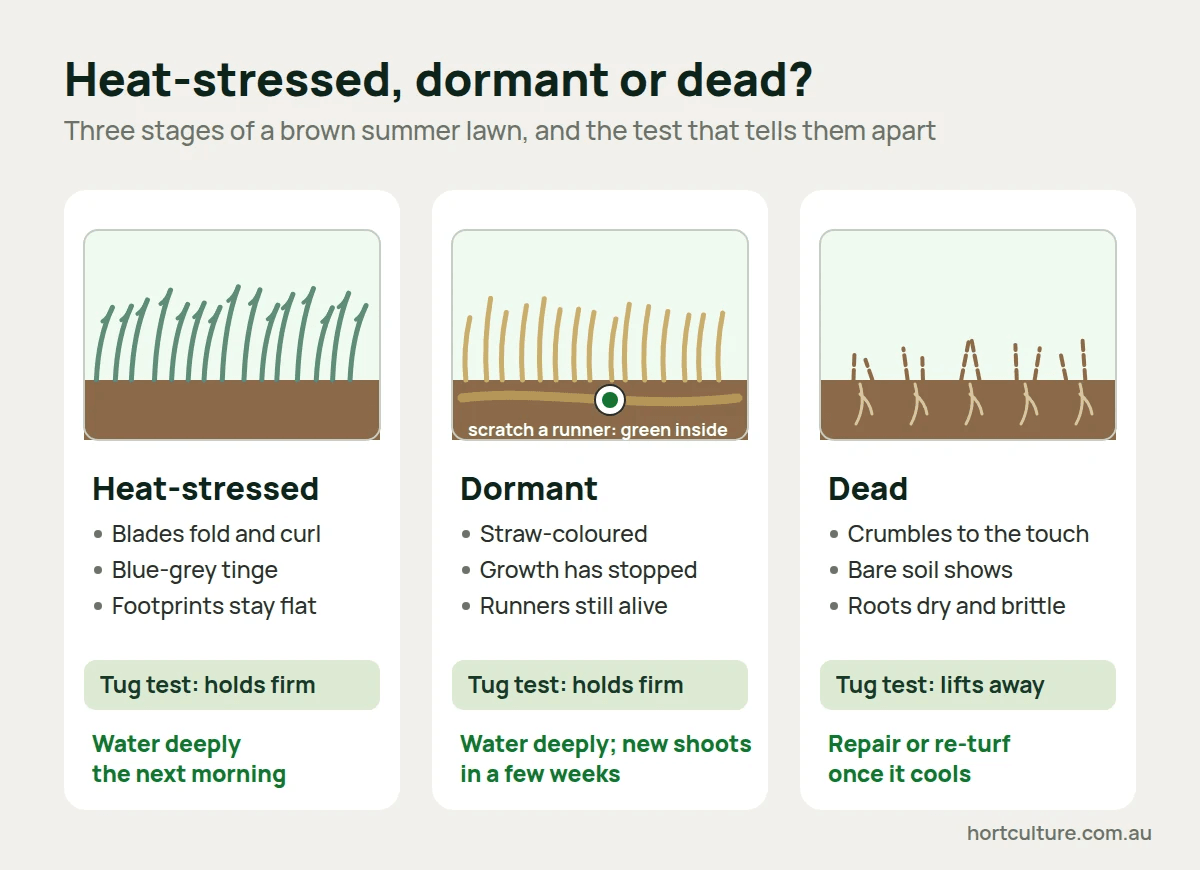
Is your lawn heat-stressed, dormant or dead?
A brown lawn in January isn’t necessarily a dead one. Warm-season grasses protect themselves in long hot, dry spells, and the fix depends on which stage your lawn is at.
| Sign | Heat-stressed | Dormant | Dead |
|---|---|---|---|
| What you see | Blades folding or curling, a dull blue-grey tinge, footprints that stay flat | Straw-coloured lawn that has stopped growing | Brown grass that crumbles, with bare soil showing through |
| Tug test | Grass holds firm | Grass holds firm; scratch a runner and it’s green or white inside | Grass lifts away easily with dry, brittle roots |
| What to do | Water deeply the next morning | Water deeply and regularly; new shoots usually appear from the runners within a few weeks | Repair or re-turf once the heat eases |
If you’re not sure, water deeply twice a week for a fortnight and watch the runners for new green shoots. If whole patches lift like loose carpet when you pull them, the roots have been eaten: check for curl grubs (see brown patches that aren’t heat below).
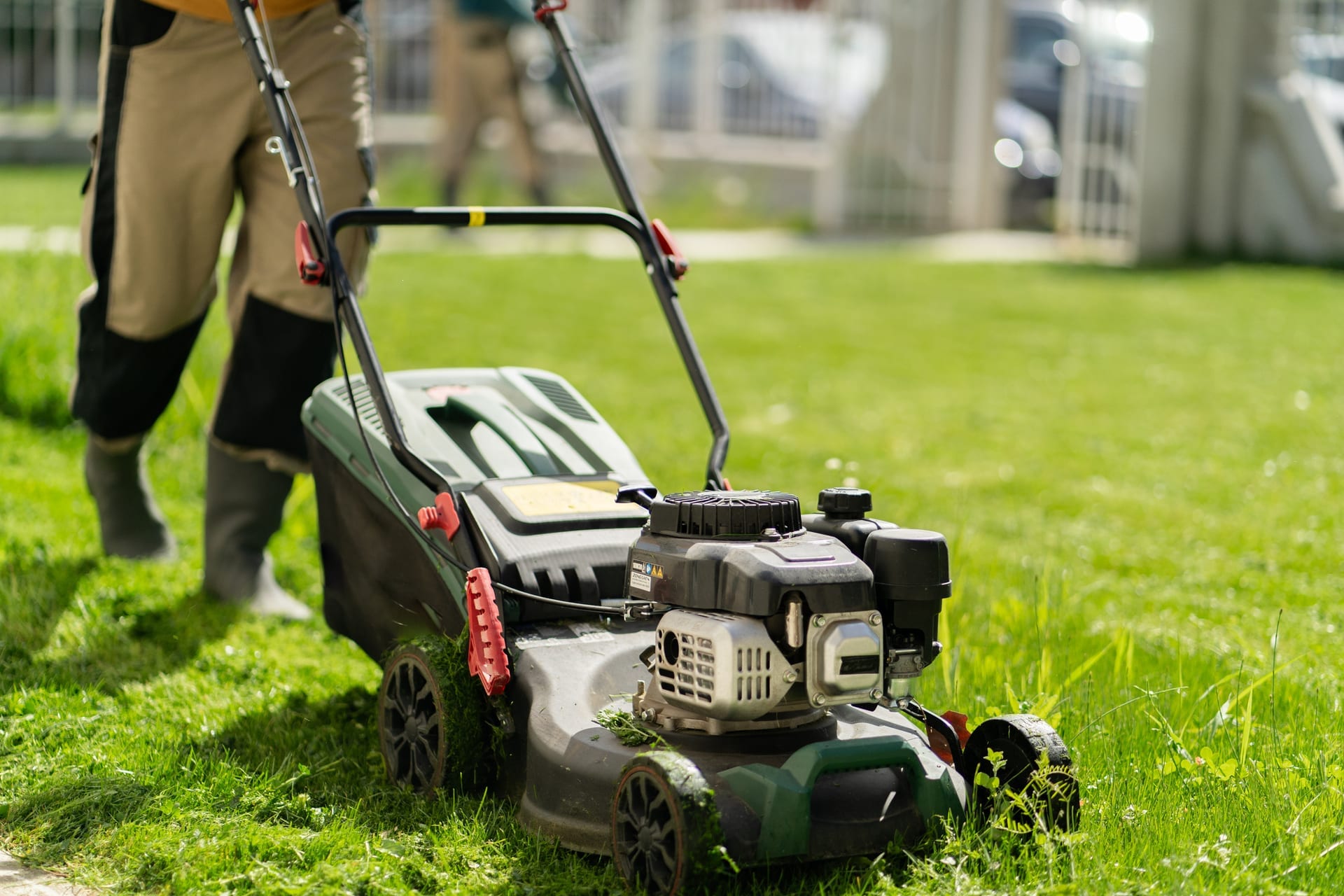
Mow higher, and less harshly
Longer grass shades the soil, keeps the root zone cooler and holds moisture. Mowing too low in the heat is the most common cause of a summer lawn going brown that we see.
| Grass | Usual mowing range | In summer heat |
|---|---|---|
| Soft leaf buffalo, including Sir Walter | 30–50mm | 40–50mm. The broad leaves shade the soil and cool the root zone |
| Kikuyu | 30–50mm | The top of the range, 40–50mm, before a heatwave |
| Couch | 10–30mm | 25–30mm. Couch tolerates a low cut, but the top of its range protects it in a dry spell |
| Zoysia | 20–40mm, depending on the variety | The top of its range. It grows slowly, so a higher cut costs little extra mowing |
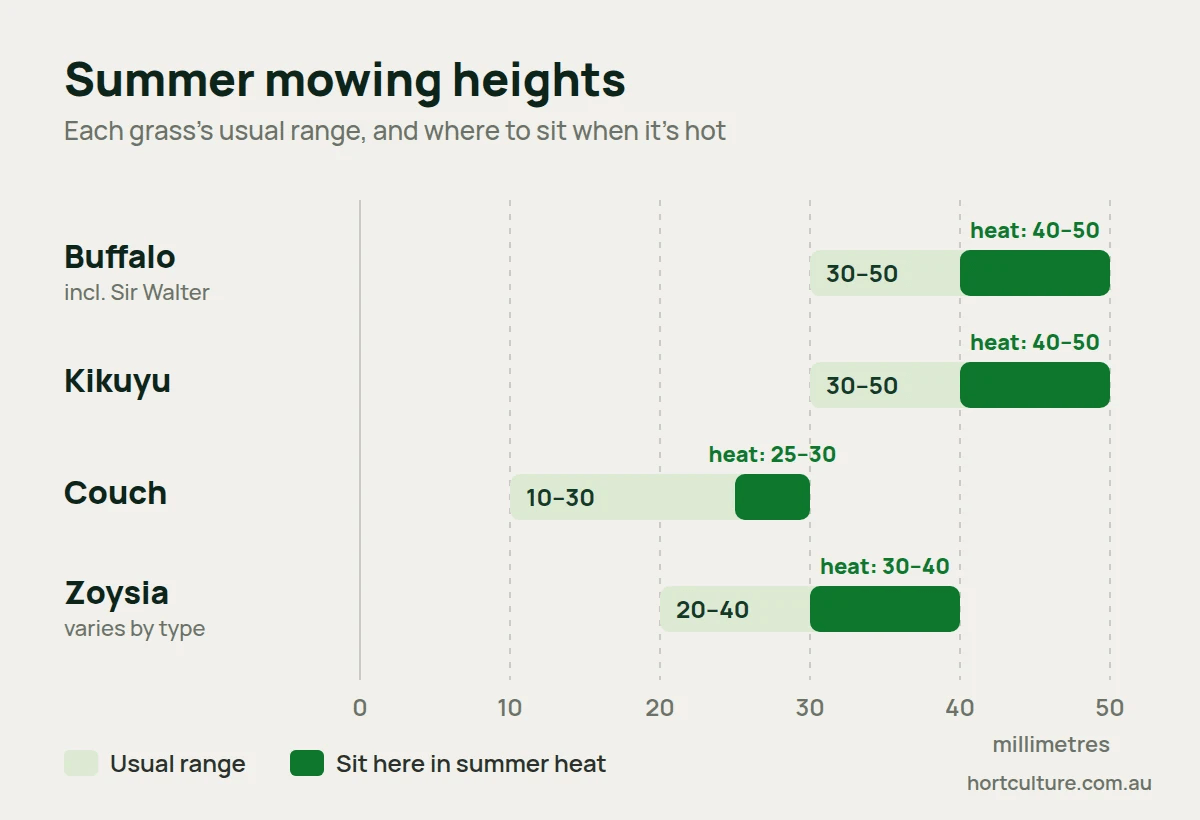
Turf growers’ ranges are a guide: in summer, mow often enough to stay within them, and sit at the top of the range when it’s hot and dry.
A few habits matter as much as the height:
- Take off no more than a third of the leaf in one cut. If the lawn has grown long, bring it down over two or three mows.
- Keep the blades sharp. Blunt blades tear the leaf, and torn tips brown off faster in the heat.
- Mow dry grass, and change direction each time. Wet grass clumps, and mowing the same line wears ruts into the soil.
- Mow in the cool of the morning or evening, and skip it when the forecast is over 30°C.
- Expect to mow every week or two through the warm months.
- If you mow yourself, leave the clippings, spread thinly, rather than catching them. They shade the soil and return nutrients as they break down.
For heights, timing and technique through the rest of the year, see our guide on how to mow a lawn properly.
Water deeply, early and evenly
Aim for about 25mm of water a week in summer, given in two deep sessions before 8am. Deep, less frequent watering draws roots down into cooler soil. A light daily sprinkle keeps them near the surface, where they dry out first in a heatwave.
- Water in the morning, not the evening. Morning water soaks in before the heat and the leaves dry during the day. Evening watering leaves them wet overnight, which in Sydney’s humidity invites fungus.
- Adjust for your soil. Sandy soils near the coast and over sandstone drain fast and may need a third session in a heatwave. Clay holds water longer, so watch for run-off instead.
- Water evenly. Corners and the spots a sprinkler misses go brown first, which often looks like a lawn problem when it’s a coverage problem.
- Don’t overdo it. Ground that stays soggy or spongy underfoot is a sign of overwatering, which weakens roots and encourages disease.
How long to run your sprinkler
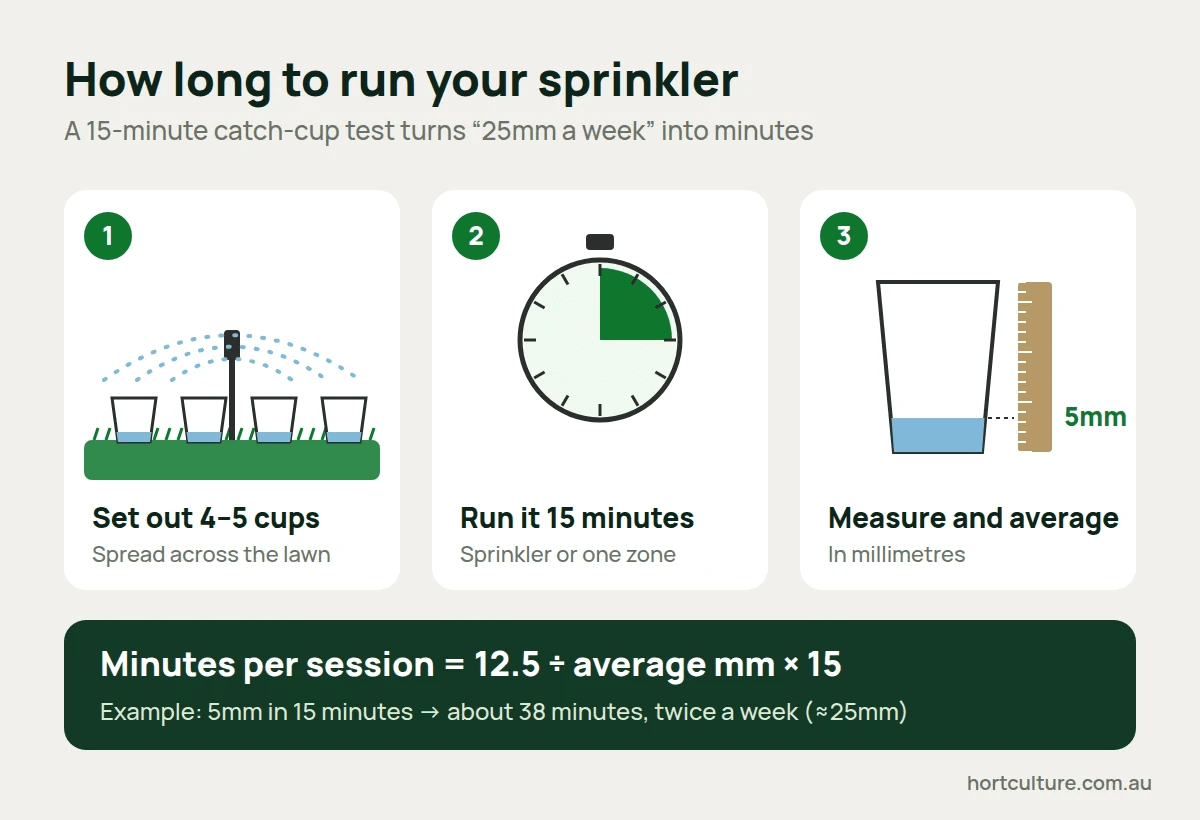
“25mm a week” only helps if you know what your sprinkler delivers. A catch-cup test takes 15 minutes:
- Place four or five straight-sided cups or tins around the lawn.
- Run the sprinkler or irrigation zone for 15 minutes.
- Measure the water in each in millimetres and take the average.
- Divide 12.5 by that average and multiply by 15. That’s how many minutes each of your two weekly sessions needs.
For example, if the cups average 5mm after 15 minutes, each session needs about 38 minutes (12.5 ÷ 5 × 15). If water starts running off before then, split the session into two runs about half an hour apart so it has time to soak in.
Sydney’s watering rules
Under Sydney Water’s Water Wise Guidelines, you can water lawns before 10am and after 4pm. Use a hose with a trigger nozzle, a sprinkler or a watering system; smart watering and drip systems may run at any time. Hoses mustn’t be left running unattended, and water shouldn’t run off onto paths or driveways. A 4am to 8am routine sits comfortably inside the rules.
For more on timing and amounts through the year, see the best time to water your lawn. If you’d rather not stand there with a hose, an irrigation system set up zone by zone does it for you.
Fix soil that sheds water
If water pools on the surface, beads up or runs into the gutter, the soil has probably become water-repellent (hydrophobic). It’s common across the North Shore and Northern Beaches, on sandy loam and on heavy clay alike. Once dry soil repels water, more watering doesn’t help until the surface is treated.
To check, push a screwdriver into the lawn an hour after watering. If it slides in easily for 10cm or more, water is reaching the roots. If it stops in the top few centimetres, it isn’t.
- Apply a soil wetting agent, spread evenly and watered in well. It breaks the surface tension so water soaks down to the roots instead of running off.
- Time it before the heat. Apply in late spring or early summer, in the cool of the morning. Most products need re-applying every 6 to 12 weeks through summer, so check the label and top up when water starts beading again.
- Relieve compaction where people walk. Paths, play areas and spots where cars park pack the soil tight. Coring opens it up so water can get in, and is best done in spring rather than in the middle of a heatwave.
Not sure whether you’re dealing with sandy soil or clay? Our guide to sandstone and clay soils on the North Shore shows how to tell with two simple tests.
Feed lightly, and not in a heatwave
Avoid high-nitrogen fertiliser during a heatwave. It forces fast growth the grass can’t support and can burn the leaf.
- Give a light, slow-release feed at the start of summer. An organic-based lawn food feeds the soil as well as the grass.
- Use liquid seaweed for a gentle boost in summer rather than another full feed.
- Feed only when it’s under 30°C. Water the lawn the day before, feed in the morning, and water it in.
- Save the main feeds for spring and autumn, when the grass can use them. Shaded lawns need less than lawns in full sun.
- Hold off on weed killer in the heat. Spraying a stressed lawn can damage the grass. Wait for a cooler spell, water first, and check the label suits your grass type; some herbicides harm buffalo.
For which weeds turn up in Sydney lawns and how to deal with them, see our guide on how to get rid of weeds.
Humid weeks: brown patch and dollar spot
Sydney summers bring humidity as well as heat, and warm, damp weeks are when lawn fungi spread fastest, especially after storms and in shaded corners. Late summer is the riskiest stretch: at Terrey Hills on the Northern Beaches, February and March are the wettest months of the year, averaging about 138mm and 175mm of rain, according to the Bureau of Meteorology.
- Brown patch shows as circular or irregular straw-coloured patches, sometimes with a darker edge, that appear during warm, humid spells.
- Dollar spot shows as small, bleached spots about the size of a coin that can merge into larger patches.
In both cases there are no caterpillars or grubs in the soil, which is how you tell fungus from the pests below. To prevent it:
- Water only in the morning, and only as much as the lawn needs, so the leaf is dry by evening.
- Let in light and air. Shade keeps the grass damp for longer. Lifting or thinning an overhanging canopy helps, but check your council’s tree rules first and use a qualified arborist.
- Go easy on nitrogen in humid weather; soft, lush growth is the most vulnerable.
- Keep mower blades sharp, since torn leaves give fungus an easy way in.
If the patches keep spreading, use a fungicide registered for that disease in home lawns and follow the label. If it comes back every summer, have it looked at: fungus, grubs and dry patch can look alike from a distance.
Brown patches that aren’t heat or fungus
Not every brown patch is the weather. In summer, check for these before changing your watering:
| Cause | What you see | How to check |
|---|---|---|
| Armyworm | Patches that grow day by day in warm, humid weather; chewed leaves; birds pecking at the lawn; small moths flying up at dusk | Pour a bucket of water with a squirt of dishwashing liquid over the edge of a patch. Caterpillars come up within 10 to 15 minutes |
| Curl grubs | Dying patches where the turf lifts like loose carpet because the roots have been eaten | Peel back a section of turf and look for C-shaped white grubs in the soil |
| Dry patch | Irregular patches that stay brown after watering while the rest greens up | Water beads or runs off; the screwdriver test stops short |
| Dog urine | Small round dead spots, often ringed with dark green grass | The spots stay the same size and match where a dog goes |
| Uneven watering | Brown corners and strips | Run the sprinkler and watch where the water doesn’t reach |
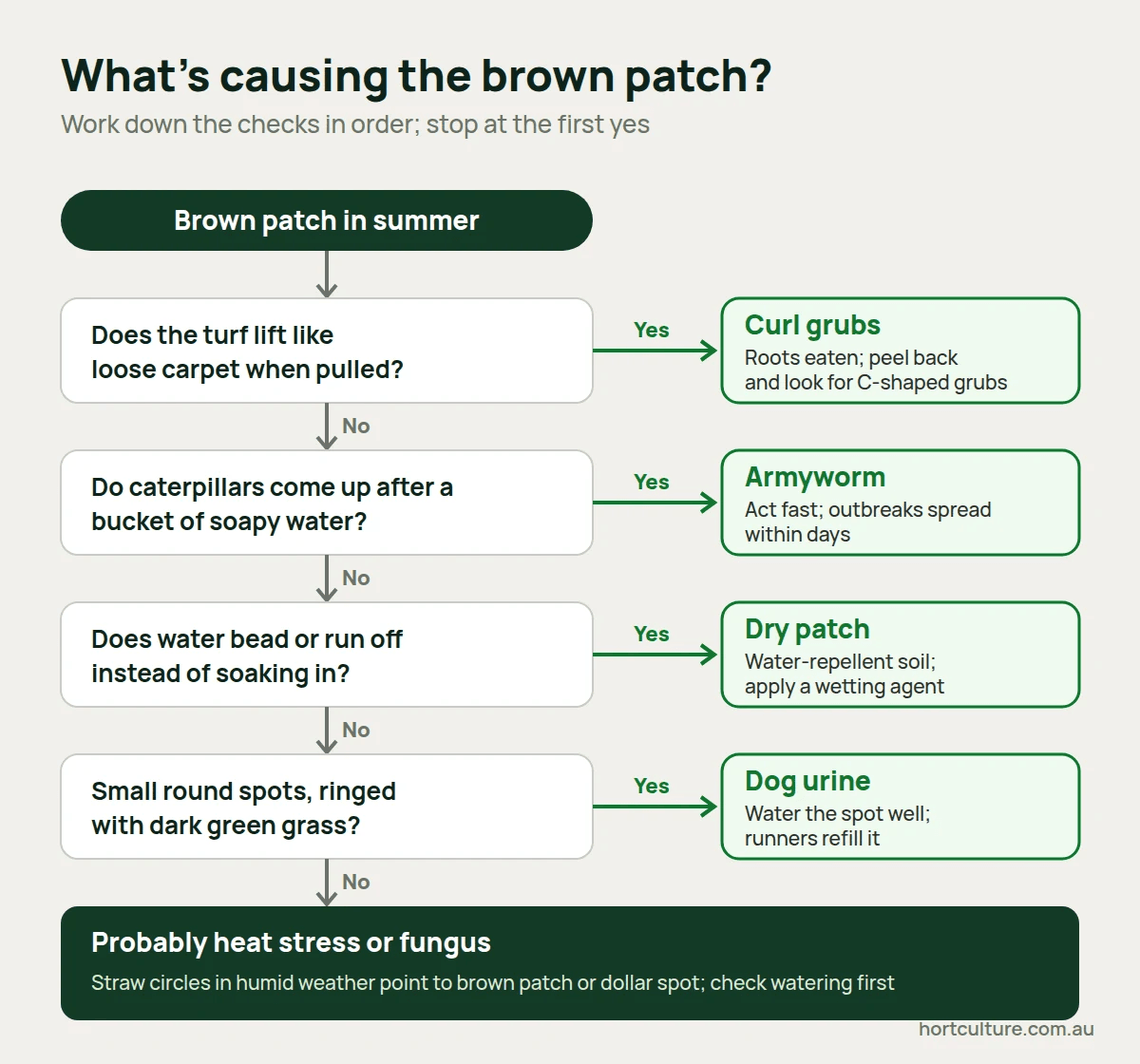
For armyworm or curl grubs, act quickly: a large outbreak can strip a lawn in days. Use an insecticide registered for that pest in home lawns and follow the label. Apply it late in the afternoon, then check again a week or two later. Our guide to armyworm in Sydney lawns walks through the test and treatment step by step.
Not sure which cause you’re looking at? On a lawn care visit, our horticulturists check whether it’s dry soil, disease or grubs before recommending anything.
If your lawn is hit every year, consider a preventative product registered for lawn grubs and armyworm, such as one based on chlorantraniliprole. Applied in late spring, it can protect the lawn through the season. After an outbreak, help the lawn recover with deep watering, a light feed and a raised mower.
Shade and high-traffic areas
Shade and foot traffic both make summer harder on a lawn, and the fixes run the other way to the advice for open, sunny lawns.
- Know what your grass can take. Soft leaf buffalo copes with about three to four hours of direct sun a day. Couch and kikuyu need full sun and thin out quickly in shade.
- Mow shaded areas a notch higher so the leaves catch more of the available light.
- Water shade less often. Shaded soil dries slowly, and constant damp invites fungus.
- Feed shade more lightly, and rake up fallen leaves before they smother the grass.
- Rest worn areas in a heatwave. Move outdoor furniture and play equipment around, and put stepping stones where people always walk.
For which grass suits which spot, see the best grass for shade in Sydney.
Rather leave it to us?
Our qualified horticulturists look after lawns across the North Shore and Northern Beaches, with the same crew every visit. We cut at the right height for the season, time feeding and aeration to the growing season, and repair worn patches. Before treating anything, we work out whether a brown patch is dry soil, a disease or grubs, so the fix matches the cause.
Book a free on-site assessment and you’ll get a written 12-month care plan and one fixed price, whether or not you go ahead. See our lawn care and maintenance service or get in touch.